
One of the joys of my adult life is challenging myself physically. My current interest is running. I enjoy running because it’s a practical way to apply—or rather, exert—my mental fortitude when my body feels like it’s hitting a wall. I recently discovered that I can improve my running even when I’m not running by focusing on strength and core training. With regular strength training, I’ve seen significant improvement in my performance, and I’ve had to give myself fewer pep talks while running.
In one of his letters to Timothy, Paul says, “Train yourself to be godly.” He goes on to say, “Physical training is good, but training for godliness is much better, promising benefits in this life and in the life to come.”
Physical training is good, but training for godliness is much better, promising benefits in this life and in the life to come.
1 Timothy 4:8
It’s easy to grasp what physical training involves—but spiritual training? That’s more of a brain teaser. It often feels like spiritual growth should happen naturally, and if I have to work at it, then maybe it’s too forced and not truly authentic. That, I believe, is one of the lies the enemy has fed our generation (myself included), and we’ve swallowed it whole.
He whispers:
“You should feel like reading your Bible.”
“You should feel like praying.”
“Memory verses are for Sunday school kids.”
But none of that lines up with “train yourself to be godly.”
So, what does spiritual training actually involve? A quick search online gave me a list of spiritual habits and disciplines for christian living. Some are intuitive, while others made me pause and reflect. Here’s what I found:
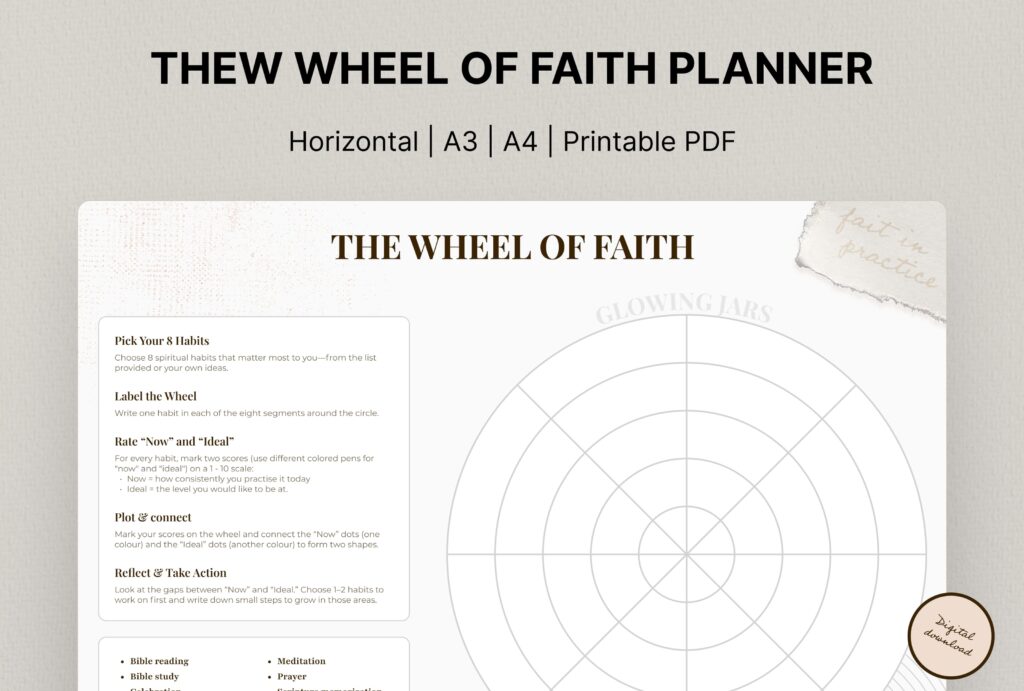
Prayer, Bible study, worship, fasting, service, scripture memorization, solitude, journaling, silence, meditation, simplicity, celebration, fellowship, gratitude, and confession.
In the coaching and self-help world, there’s a popular tool called the Wheel of Life. It’s a visual framework that helps people assess key areas of their life—like career, health, relationships, finances, and personal growth. Each area is represented as a segment in a circle, and the idea is to identify what’s thriving and what needs attention.
Inspired by that concept, I created a spiritual habits wheel—a downloadable PDF you can use to assess where you are spiritually and create an action plan.
Join me over the next few weeks as I explore practical ways to train ourselves to be godly using the spiritual disciplines listed above.
Well done. This resonated with me.
Thanks for the challenge